Esna Lock | Esna, Egypt Day 2
After our sight seeing for the day, we returned to the cruise ship. The cruise ship was set to sail to Esna that night. And on the day when the cruise ship sails, there is tea served on the top deck. So after we had checked out the small jewelry store in the ship, we went up to the top deck for tea at about 4.30pm.
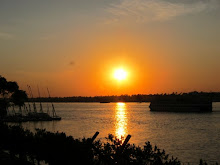
The deck was not at all crowded - which suited me great. I just abhor crowds! We had the place almost to ourselves. The cruise ship moves along at a steady speed - not too fast though. We busied ourselves taking pictures of the glorious sunset (sunset was at about 5.20pm).
After dinner, I went up deck again to relax. There was soft piped music playing - Celine Dion of all was featured! I would have preferred something local, but ah well. It was still nice to sit by the dimmed lights and enjoy the breeze.
Then out of the dark waters, I heard a voice calling out hello twice, then added "I am here". Initially, I thought it might be someone on a cellphone. But when the voice came again, I got concerned, wondering for a moment, if someone had fallen overboard. That was a scary moment.
I went to check, peering over the rails. But I could see nothing. But as soon as I did that, the voice called out again. As my eyes adjusted to the dark, I realized that there was a man in a small row boat. He was being pulled along from the back of the cruise ship - apparently, he had attached his small boat to the cruise ship with a rope. Instantly, it came to me what this might all be.
Before my trip, I had read that as the cruise ship neared Esna Lock, the nearby villagers would approach the cruise ships in row boats, selling their wares from galabiyas (long dresses) to shawls. But all the accounts I had read about had occured during the day time. And the accounts had not said anything about peddlers attempting to sell things while the cruise ship was moving!
I sent a friend to get a touch light as it was impossible to see the man holding up his wares. But even with the torch light, it was impossible to see anything. We shouted and gestured for the man to move to the side of the boat.
He did this, and suddenly many other small boats appeared and latched themselves to the cruise ship. Meanwhile, all the ruckus brought the guests up the deck. As I am a true shopaholic, I got very excited - asking to see what they had.
I dealt with the first man we had encountered. How it worked was this - he asked if we were interested in galabiyas. I said yes. Then he asked for color. I said blue. Then he places a glalabiya into a plastic bag, and throws it up to the top deck. Mind you, the cruise ship is about 4 stories high! That was some aim. As soon as we got the bag, we checked it. This process happened many times as we selected our galabiyas - I wanted a smaller size (size three was the smallest, but still a bit big for me), another friend wanted a black large sized galabiya. It was so much fun.
After we had selected our galabiyas, then the bargaining occurred. The sellers could speak English, so that it easier. We bargained down our galabiyas to 55 Egyptian Pounds a piece. The main reason why I stopped bargaining was because we were fast approaching the Esna Lock, and I could see the cruise ship approaching the dock area. The row boats were being squeezed between the ship and the banks of the dock. I was so afraid that they would be crushed. So I insisted we stop bargaining and just give them the money....
After we settled on the price, we placed the money into a plastic bag with an item we did not want. Then our Egyptian tour guide, who had somehow appeared while we were busy bargaining, helped us to throw the bag back to the seller.

Some Kids in Our Group Holding Up Our Purchases
What an exciting event. That could never happen elsewhere, I think!
As we neared the Esna Lock, we all proceeded to the front of the boat to watch the process. We were very lucky that the Esna Lock was not closed for maintenance - usually between the 1st and 15th of December, the Lock would be closed, and those on the Nile cruises would have to take a bus from Luxor to Esna instead of cruising down the Nile. Thankfully we passed through!
The lock is a device for raising and lowering boats between stretches of water of different levels on river and canal waterways. The distinguishing feature of a lock is a fixed chamber whose water level can be varied.


 Esna Lock - December 9, 2009.
The deck was not at all crowded - which suited me great. I just abhor crowds! We had the place almost to ourselves. The cruise ship moves along at a steady speed - not too fast though. We busied ourselves taking pictures of the glorious sunset (sunset was at about 5.20pm).
After dinner, I went up deck again to relax. There was soft piped music playing - Celine Dion of all was featured! I would have preferred something local, but ah well. It was still nice to sit by the dimmed lights and enjoy the breeze.
Then out of the dark waters, I heard a voice calling out hello twice, then added "I am here". Initially, I thought it might be someone on a cellphone. But when the voice came again, I got concerned, wondering for a moment, if someone had fallen overboard. That was a scary moment.
I went to check, peering over the rails. But I could see nothing. But as soon as I did that, the voice called out again. As my eyes adjusted to the dark, I realized that there was a man in a small row boat. He was being pulled along from the back of the cruise ship - apparently, he had attached his small boat to the cruise ship with a rope. Instantly, it came to me what this might all be.
Before my trip, I had read that as the cruise ship neared Esna Lock, the nearby villagers would approach the cruise ships in row boats, selling their wares from galabiyas (long dresses) to shawls. But all the accounts I had read about had occured during the day time. And the accounts had not said anything about peddlers attempting to sell things while the cruise ship was moving!
I sent a friend to get a touch light as it was impossible to see the man holding up his wares. But even with the torch light, it was impossible to see anything. We shouted and gestured for the man to move to the side of the boat.
He did this, and suddenly many other small boats appeared and latched themselves to the cruise ship. Meanwhile, all the ruckus brought the guests up the deck. As I am a true shopaholic, I got very excited - asking to see what they had.
I dealt with the first man we had encountered. How it worked was this - he asked if we were interested in galabiyas. I said yes. Then he asked for color. I said blue. Then he places a glalabiya into a plastic bag, and throws it up to the top deck. Mind you, the cruise ship is about 4 stories high! That was some aim. As soon as we got the bag, we checked it. This process happened many times as we selected our galabiyas - I wanted a smaller size (size three was the smallest, but still a bit big for me), another friend wanted a black large sized galabiya. It was so much fun.
After we had selected our galabiyas, then the bargaining occurred. The sellers could speak English, so that it easier. We bargained down our galabiyas to 55 Egyptian Pounds a piece. The main reason why I stopped bargaining was because we were fast approaching the Esna Lock, and I could see the cruise ship approaching the dock area. The row boats were being squeezed between the ship and the banks of the dock. I was so afraid that they would be crushed. So I insisted we stop bargaining and just give them the money....
After we settled on the price, we placed the money into a plastic bag with an item we did not want. Then our Egyptian tour guide, who had somehow appeared while we were busy bargaining, helped us to throw the bag back to the seller.

What an exciting event. That could never happen elsewhere, I think!
As we neared the Esna Lock, we all proceeded to the front of the boat to watch the process. We were very lucky that the Esna Lock was not closed for maintenance - usually between the 1st and 15th of December, the Lock would be closed, and those on the Nile cruises would have to take a bus from Luxor to Esna instead of cruising down the Nile. Thankfully we passed through!
The lock is a device for raising and lowering boats between stretches of water of different levels on river and canal waterways. The distinguishing feature of a lock is a fixed chamber whose water level can be varied.


 Esna Lock - December 9, 2009.
Labels: Egypt, Egypt Day 2
posted by Simply Travels at
8:38 AM
0 Comments